stereograms.illusions.im
How do two flat pictures look solid?
Take two almost identical drawings, or two almost identical photographs, made from slightly different angles — one for each eye — and something strange can happen. Official wording says they may appear to exist in three dimensions in space. A popular term is 3-D. In 1838 Charles Wheatstone gave the instrument that shows them a name: a Stereoscope, “to indicate its property of representing solid figures.”
How do two flat pictures look solid?
Pick a story. Official pages treat stereoscopy as two slightly different flat pictures, one for each eye, that can look solid in space. Charles Wheatstone named the stereoscope in 1838. The Library of Congress still keeps a careful official history of the cards people held in their hands.
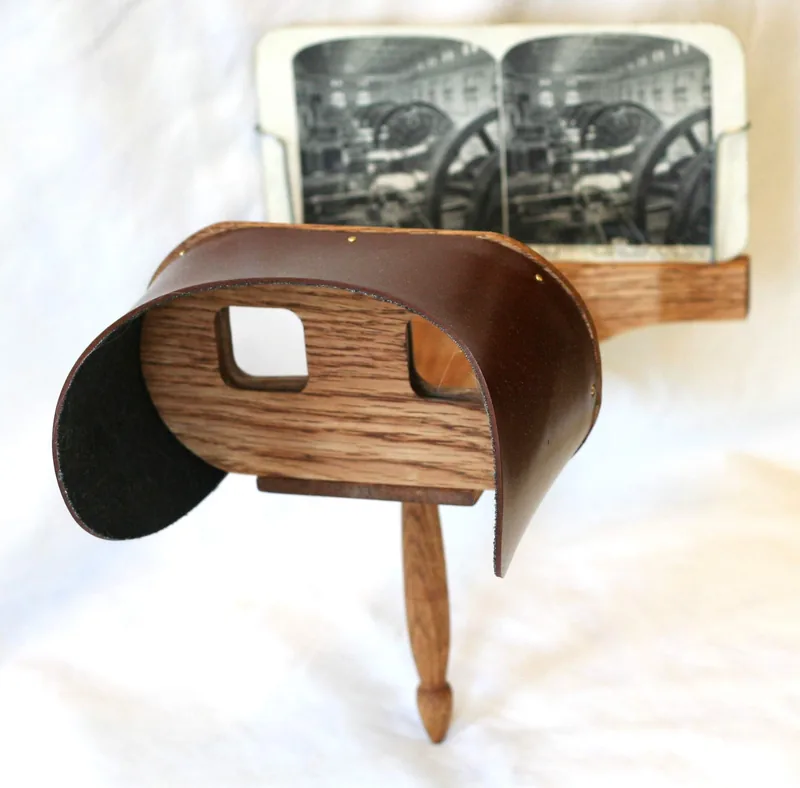
The wooden viewer on this page is a modern reproduction of a Holmes-type stereoscope, photographed in 2006. Official Library of Congress wording says that in 1859 the physician and poet Oliver Wendell Holmes designed a hand-held viewer for stereoscopes. The still is a reproduction. It is not an antique, and it is not a picture of 1859. [source]
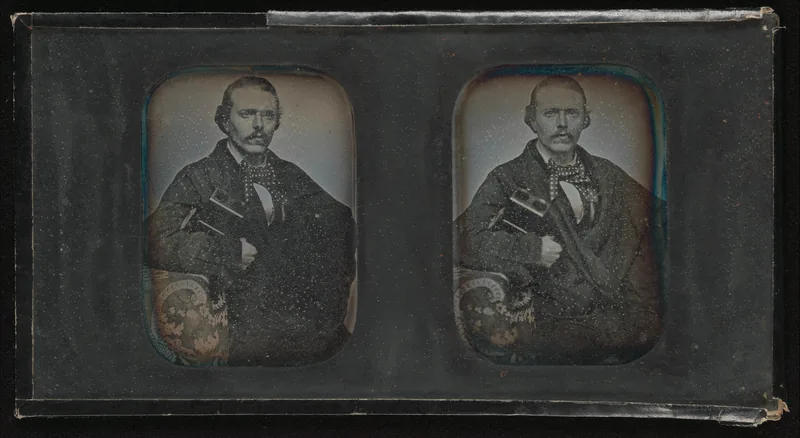
A stereograph is, in official wording, two nearly identical photographs or photomechanical prints, paired to produce the illusion of a single three-dimensional image, usually when viewed through a stereoscope. Official wording also says an experienced observer may manage without a box; ordinarily, some device is used so that each eye sees only the appropriate picture. The card above, from the Metropolitan Museum of Art, even shows a man holding a viewer. Its file dates it to the 1840s–60s, a range that is kept as written, and is not used to “correct” the official wording that stereographs were first made in the 1850s.
Enjoyed this desk of two flat pictures that look solid?
No pop-ups. No intrusive advertising. Just interesting stuff. A little support helps the next illusions.im site get built.