Each story is taken from Wheatstone’s 1838 wording, from official Encyclopaedia Britannica and Library of Congress pages, or from a clearly dated, licence-checked photograph caption. Nothing here is invented, and official figures that disagree are kept apart.
In 1838 Wheatstone proposed the name “to indicate its property of representing solid figures.” The paper was received and read on 21 June 1838.
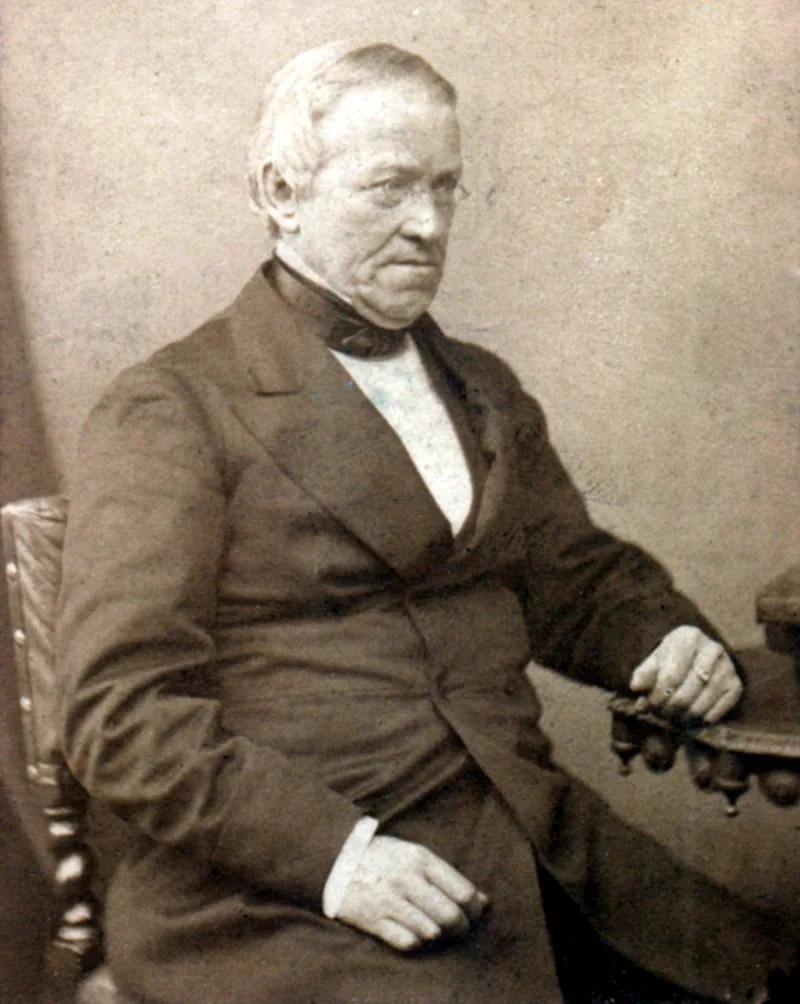
A portrait of Charles Wheatstone, dated on the file as before 1875. Encyclopaedia Britannica gives his dates as 6 February 1802, Gloucester, to 19 October 1875, Paris, and names the stereoscope among his inventions. This is a portrait. It is not a picture of the 1838 paper, or of the instrument he named.Photo: Unidentified photographer · Public domain · Wikimedia Commons
His own wording describes two plane mirrors, about four inches square, “so adjusted that their backs form an angle of 90° with each other.”
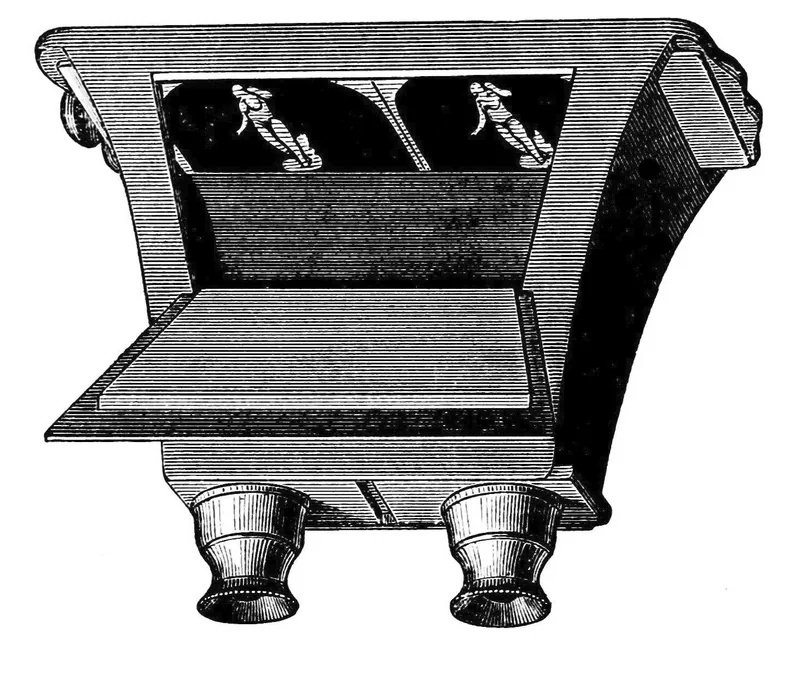
An illustration titled, on the file, “The Brewster stereoscope 1849,” published in Popular Science Monthly, volume 21, in 1882. The 1882 publication date and the 1849 file title are kept apart. This is an 1882 illustration, not a photograph of an instrument in 1849.Illustration: Unknown artist, Popular Science Monthly, volume 21, 1882 · Public domain · Wikimedia Commons
Encyclopaedia Britannica names the stereoscope among Wheatstone’s inventions, “still used in viewing X-rays and aerial photographs.” The official biography also names the concertina.
A portrait of Charles Wheatstone, dated on the file as before 1875. Encyclopaedia Britannica gives his dates as 6 February 1802, Gloucester, to 19 October 1875, Paris, and names the stereoscope among his inventions. This is a portrait. It is not a picture of the 1838 paper, or of the instrument he named.Photo: Unidentified photographer · Public domain · Wikimedia Commons
Official wording says an experienced observer may manage without a stereoscope. Ordinarily, some device is used so each eye sees only the appropriate picture.
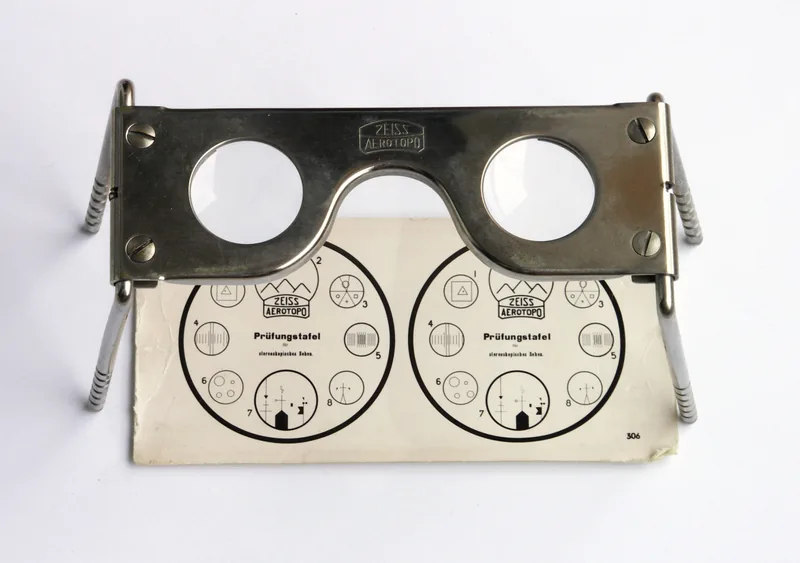
A pocket stereoscope from Zeiss, with its original test image, photographed by Joaquim Alves Gaspar in October 2006. The file says the instrument’s date is unknown, “but probably from the fifties.” That “probably” stays with the photographer’s wording, and is not asserted here as a fact.Photo: Joaquim Alves Gaspar · CC BY 2.5 · Wikimedia Commons
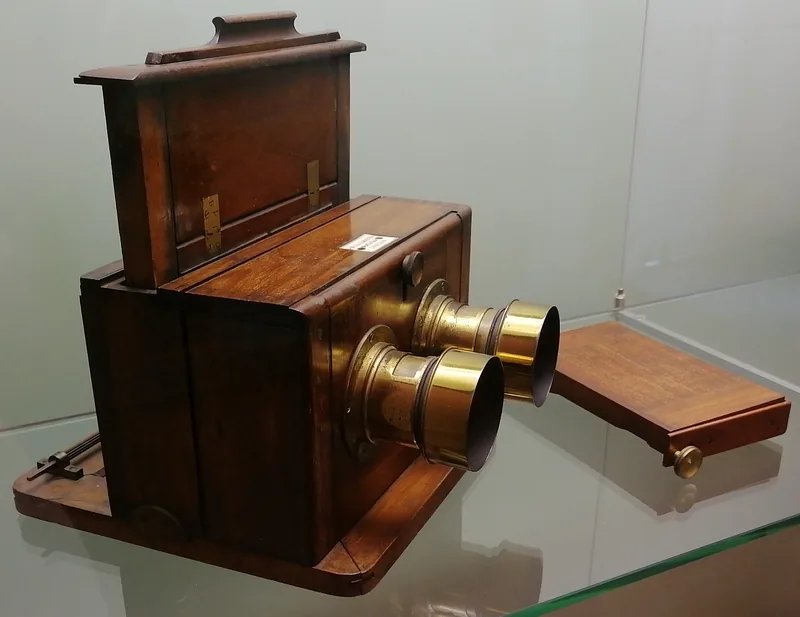
Official wording says stereoscopic pictures are produced in pairs from slightly different angles. A Dallmeyer stereoscopic camera was built to take that pair.
A nineteenth-century stereoscopic camera made in London by the optician J. H. Dallmeyer (John Henry Dallmeyer), photographed by Carlos Teixidor Cadenas on 19 July 2022 at the Centro Português de Fotografia, Porto. Official wording says stereoscopic pictures are produced in pairs from slightly different angles corresponding to the two eyes. This still shows a camera built to take such a pair. Used on the website only, under CC BY-SA 4.0, and not placed in the typographic fact sheets.Photo: Carlos Teixidor Cadenas · CC BY-SA 4.0 (website only) · Wikimedia Commons
Official Library of Congress wording: stereographs consist of two nearly identical photographs or photomechanical prints, paired to produce the illusion of a single three-dimensional image.
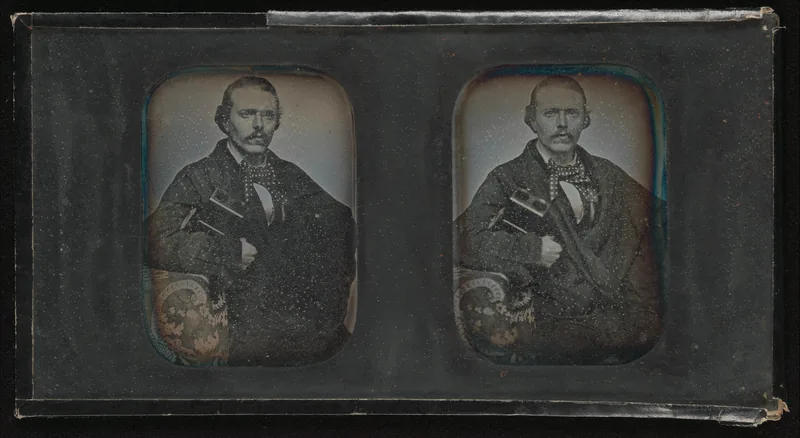
A stereoscopic portrait of a man holding a stereoscopic viewer, from the Metropolitan Museum of Art. The file dates the still to the 1840s–60s, a range that is kept as written and is not used to “correct” the Library of Congress wording that stereographs were first made in the 1850s. Public domain / CC0.Stereograph: Unknown photographer. The Metropolitan Museum of Art · CC0 · Metropolitan Museum of Art / Wikimedia Commons
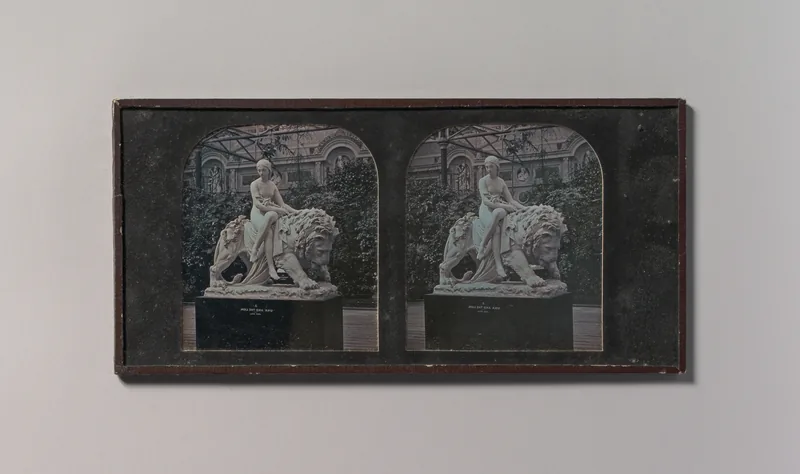
Official wording: in 1851 stereo daguerreotypes were exhibited for the first time to the general public at the London International Exhibition (Crystal Palace).
A stereograph of John Bell’s “Una and the Lion” at the Crystal Palace, by the London Stereoscopic and Photographic Company, in the Metropolitan Museum of Art. The file dates it between 1854 and 1862 — after the palace had been moved to Sydenham. Official Library of Congress wording places the first public exhibition of stereo daguerreotypes at the 1851 London International Exhibition (Crystal Palace). Those two official date ranges are kept apart. Public domain / CC0.Stereograph: London Stereoscopic and Photographic Company. The Metropolitan Museum of Art · CC0 · Metropolitan Museum of Art / Wikimedia Commons
A stereograph of John Bell’s “Una and the Lion” is dated on its file between 1854 and 1862, after the palace had moved to Sydenham. That later range is not blended with 1851.
A stereograph of John Bell’s “Una and the Lion” at the Crystal Palace, by the London Stereoscopic and Photographic Company, in the Metropolitan Museum of Art. The file dates it between 1854 and 1862 — after the palace had been moved to Sydenham. Official Library of Congress wording places the first public exhibition of stereo daguerreotypes at the 1851 London International Exhibition (Crystal Palace). Those two official date ranges are kept apart. Public domain / CC0.Stereograph: London Stereoscopic and Photographic Company. The Metropolitan Museum of Art · CC0 · Metropolitan Museum of Art / Wikimedia Commons
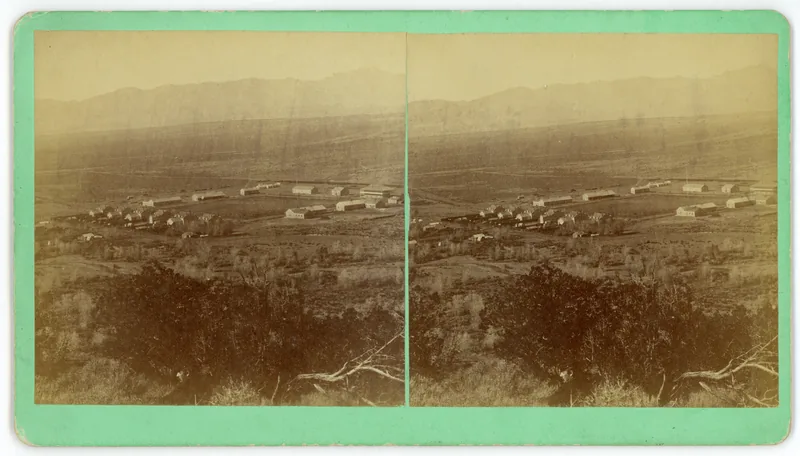
Official wording says stereographs were most popular between 1870 and 1920, and are still made today. A Fort Cameron card, circa 1875, sits inside that official span.
A stereograph card of Fort Cameron, Utah Territory, seen from the nearby hills, photographed by James Fennemore, circa 1875. Official Library of Congress wording says stereographs were most popular between 1870 and 1920. This card sits in that official span. It is a pair of photographs on a card. It is not a view through a stereoscope.Stereograph: James Fennemore. Scan by Wikimedia Commons user Beneathtimp · Public domain · Wikimedia Commons
The same official Library of Congress page gives “more than 50,000” cards and “approximately 52,000” stereographs. This desk keeps both figures.
A stereograph card of Fort Cameron, Utah Territory, seen from the nearby hills, photographed by James Fennemore, circa 1875. Official Library of Congress wording says stereographs were most popular between 1870 and 1920. This card sits in that official span. It is a pair of photographs on a card. It is not a view through a stereoscope.Stereograph: James Fennemore. Scan by Wikimedia Commons user Beneathtimp · Public domain · Wikimedia Commons
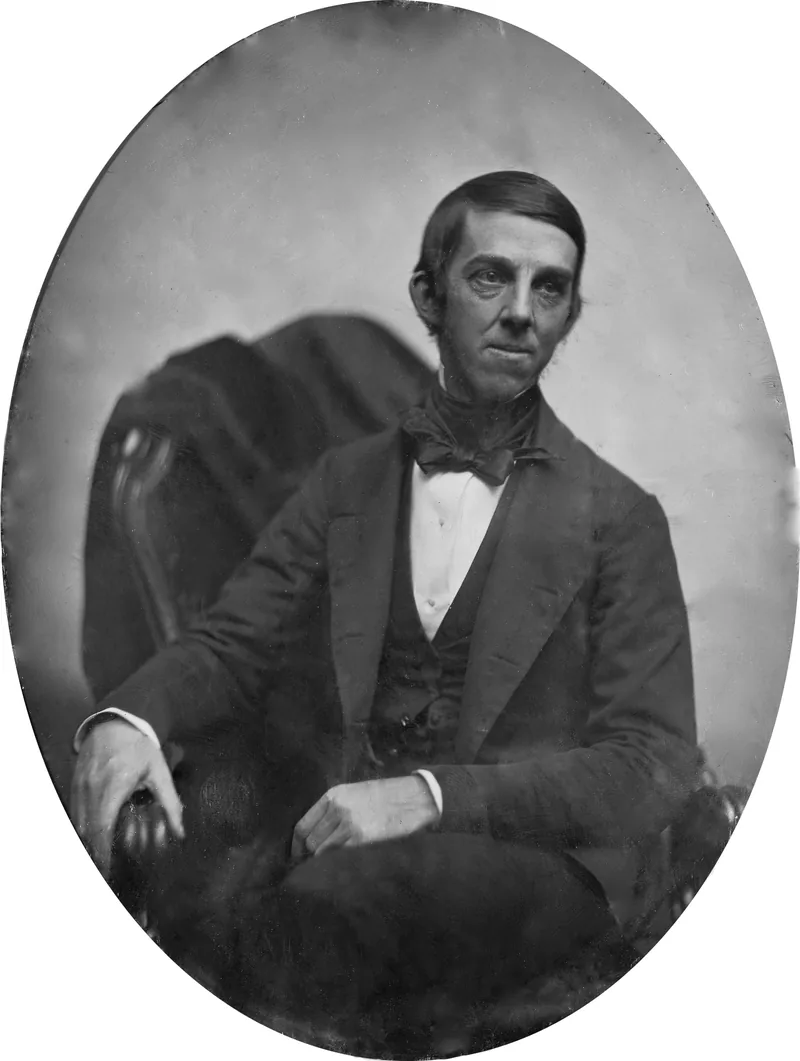
In 1859, official wording says, the physician and poet Oliver Wendell Holmes designed a hand-held viewer for stereoscopes.
A daguerreotype of Oliver Wendell Holmes Sr., by Josiah Johnson Hawes, dated on the file as between about 1850 and about 1856, courtesy of the Harvard University Library. Official Library of Congress wording says that in 1859 Holmes designed a hand-held viewer for stereoscopes. This is a portrait from a file range that ends a little before that official year. It is not a picture of the viewer, or of the year 1859.Daguerreotype: Josiah Johnson Hawes. Harvard University Library · Public domain · Harvard University Library / Wikimedia Commons
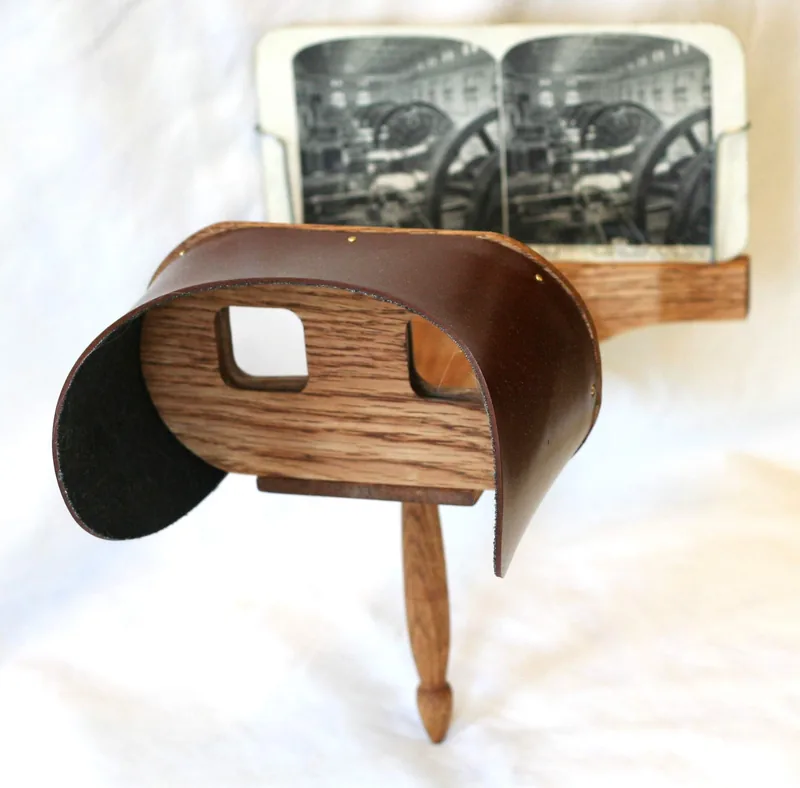
The wooden Holmes-type viewer on this site was photographed in 2006. The file already calls it a reproduction. A Commons banner calling that file a stereogram is not repeated as a fact.
A reproduction Holmes stereoscope, photographed by Davepape on 5 June 2006. Official Library of Congress wording says that in 1859 the physician and poet Oliver Wendell Holmes designed a hand-held viewer for stereoscopes. This still is a modern reproduction of that kind of viewer. It is not an antique instrument, and it is not itself a stereograph pair.Photo: Davepape · Public domain / CC0 · Wikimedia Commons
A Metropolitan Museum card of a man holding a viewer is dated 1840s–60s. That range is not used to “correct” the official wording that stereographs were first made in the 1850s.
A stereoscopic portrait of a man holding a stereoscopic viewer, from the Metropolitan Museum of Art. The file dates the still to the 1840s–60s, a range that is kept as written and is not used to “correct” the Library of Congress wording that stereographs were first made in the 1850s. Public domain / CC0.Stereograph: Unknown photographer. The Metropolitan Museum of Art · CC0 · Metropolitan Museum of Art / Wikimedia Commons
An illustration published in 1882 is titled on the file “The Brewster stereoscope 1849.” The publication date and the file title are kept apart.
An illustration titled, on the file, “The Brewster stereoscope 1849,” published in Popular Science Monthly, volume 21, in 1882. The 1882 publication date and the 1849 file title are kept apart. This is an 1882 illustration, not a photograph of an instrument in 1849.Illustration: Unknown artist, Popular Science Monthly, volume 21, 1882 · Public domain · Wikimedia Commons
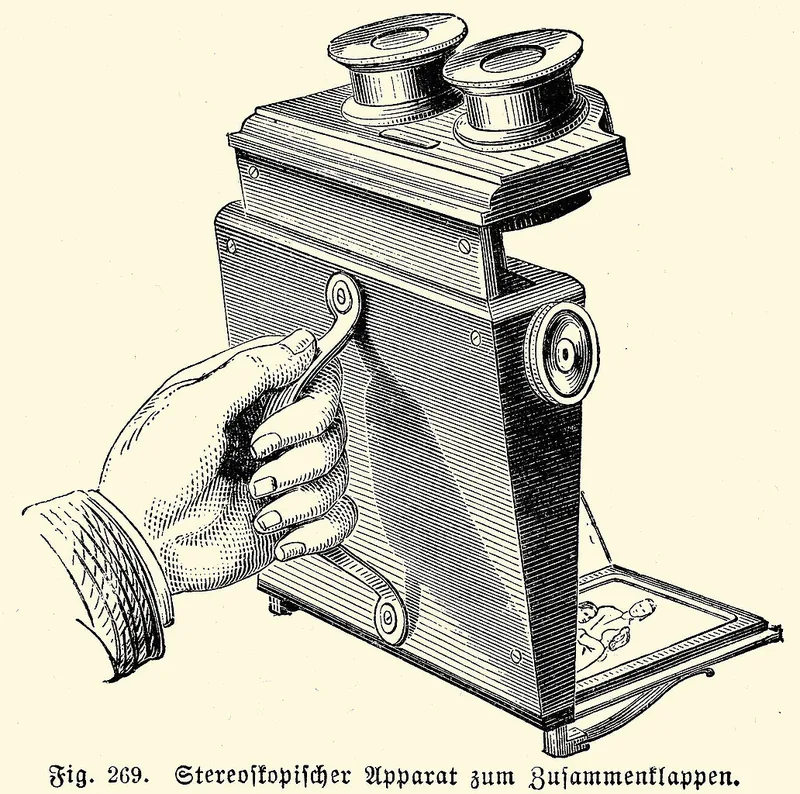
An 1877 folding viewer file reads “David Brewster constr.” That wording stays with the file, and is not treated as a claim that Brewster made the 1877 instrument.
A folding hand-held lenticular stereoscope, dated 1877 on the file, which also reads “David Brewster constr.” That file wording is kept with the file. It is not treated as a claim that Brewster made this 1877 instrument. The still is an illustration of a later folding viewer.Illustration: Unknown artist · Public domain · Wikimedia Commons
A 2006 photograph of a Zeiss pocket stereoscope says the instrument is “probably from the fifties.” That “probably” stays with the photographer’s wording.
A pocket stereoscope from Zeiss, with its original test image, photographed by Joaquim Alves Gaspar in October 2006. The file says the instrument’s date is unknown, “but probably from the fifties.” That “probably” stays with the photographer’s wording, and is not asserted here as a fact.Photo: Joaquim Alves Gaspar · CC BY 2.5 · Wikimedia CommonsKeep the lights on
Enjoyed this desk of two flat pictures that look solid?
No pop-ups. No intrusive advertising. Just interesting stuff. A little support helps the next illusions.im site get built.