Myths versus facts
Checked claims
A few claims that are easy to pick up, and the official wording that answers them. Photographs on this site introduce official examples. They do not, by themselves, change official dates.
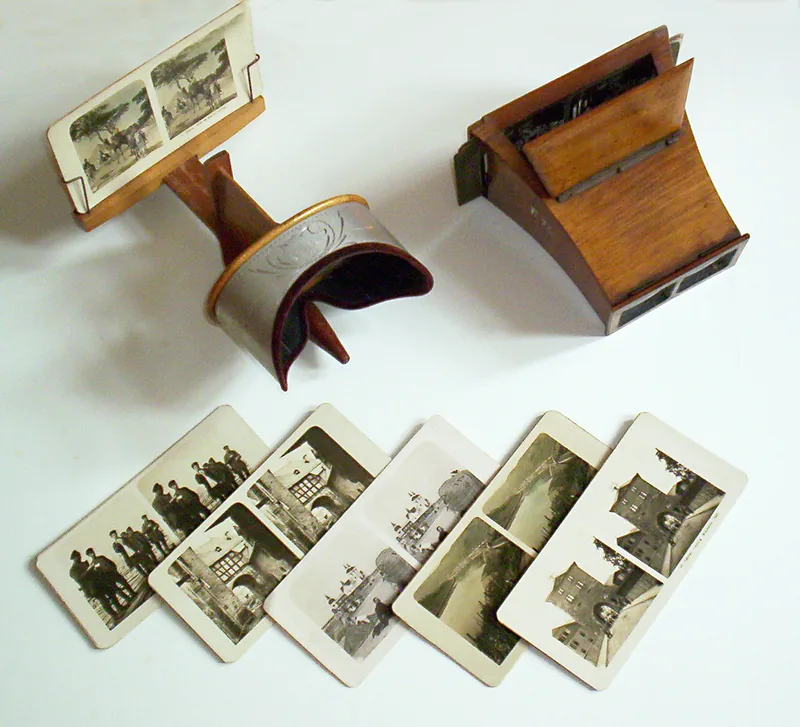
A photograph of a Holmes-type viewer is an antique stereoscope from 1859.
The still on this site is a modern reproduction, photographed in 2006. The file already calls it a reproduction. Official wording places Holmes’s design in 1859; the photograph is not that year, and not that object. [source]
The 1854–1862 Crystal Palace card is the 1851 exhibition.
Official wording places the first public exhibition of stereo daguerreotypes at the 1851 Crystal Palace. The card of “Una and the Lion” is dated on its file between 1854 and 1862, after the palace had moved. Those dates stay apart. [source]
Stereographs were first made in the 1840s, because one museum file says 1840s–60s.
Official Library of Congress wording says they were first made in the 1850s. A file range of 1840s–60s is kept as a file range, and is not used to “correct” that official wording. [source]
The Library of Congress holds exactly 51,000 stereographs.
The same official page gives two figures — more than 50,000 cards in the division’s holdings, and approximately 52,000 stereographs organized and available in the collection. This desk does not blend them. [source]
Britannica’s Wheatstone biography dates the stereoscope to 1838.
The official biography names the invention, and gives birth, death and knighthood dates, but does not give 1832 or 1838. The 21 June 1838 date comes from the paper itself, “Received and Read.” [source] [source]
An experienced observer cannot see the effect without a stereoscope.
Official wording says an experienced observer of stereopairs may be able to achieve the proper focus and convergence without special viewing equipment. Ordinarily, some device is used. [source]
The 1877 folding viewer was made by Brewster.
The file reads “David Brewster constr.” That wording stays with the file, and is not treated as a claim that Brewster made the 1877 instrument. [source]
The 1882 magazine picture is a photograph of an 1849 instrument.
It is an illustration published in 1882, with a file title that mentions 1849. The publication date and the title are kept apart. [source]
The Zeiss pocket viewer is officially from the 1950s.
The 2006 file says the date is unknown, “but probably from the fifties.” That “probably” stays with the photographer’s wording. [source]
This site’s two drawings are a hidden-image “magic” picture.
They are an original line diagram of a box, drawn twice from slightly different angles. This site does not use a commercial hidden-image trademark as if it were a ReallyByte name, and it does not reproduce copyrighted hidden-image pictures. [source]
The Science Museum’s Wheatstone instrument is shown in a photograph here.
It is not. Official date wording from that record is cited — “c. 1850” and “1845-1855,” kept apart — but no photograph from that page is used, because the licence is not one this site may use. [source]
A portrait of Holmes from about 1850 to 1856 shows him with his 1859 viewer.
It is a portrait, dated on the file as between about 1850 and about 1856. Official wording places the viewer design in 1859. The still is not a picture of that year, or of the instrument. [source]
Enjoyed this desk of two flat pictures that look solid?
No pop-ups. No intrusive advertising. Just interesting stuff. A little support helps the next illusions.im site get built.