Home · Stereographs
Cards you could hold
The stereograph craze
Official Library of Congress wording is the spine of this page. Stereographs consist of two nearly identical photographs or photomechanical prints, paired to produce the illusion of a single three-dimensional image, usually when viewed through a stereoscope. They were first made in the 1850s and are still made today. They were most popular between 1870 and 1920. [source]
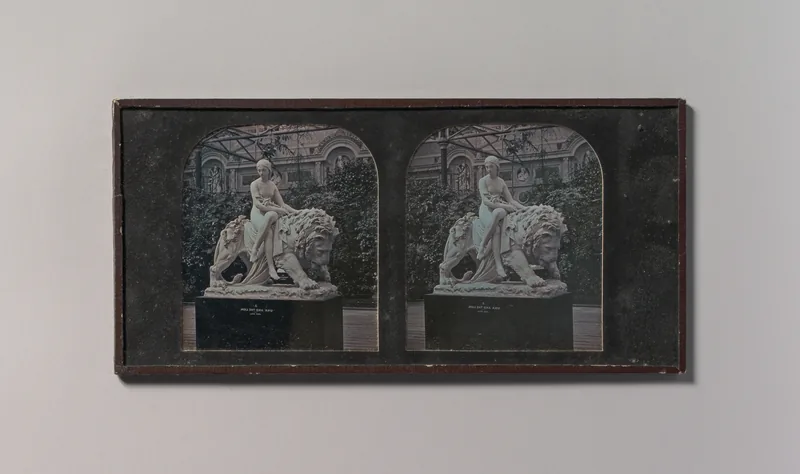
Official wording also says that in 1851 stereo daguerreotypes were exhibited for the first time to the general public at the London International Exhibition (Crystal Palace). The card above is later. It is a stereograph of John Bell’s “Una and the Lion” at the Crystal Palace, by the London Stereoscopic and Photographic Company, dated on its file between 1854 and 1862 — after the palace had been moved to Sydenham. The official 1851 exhibition and this later card are kept as two different official date ranges. They are not treated as one event.
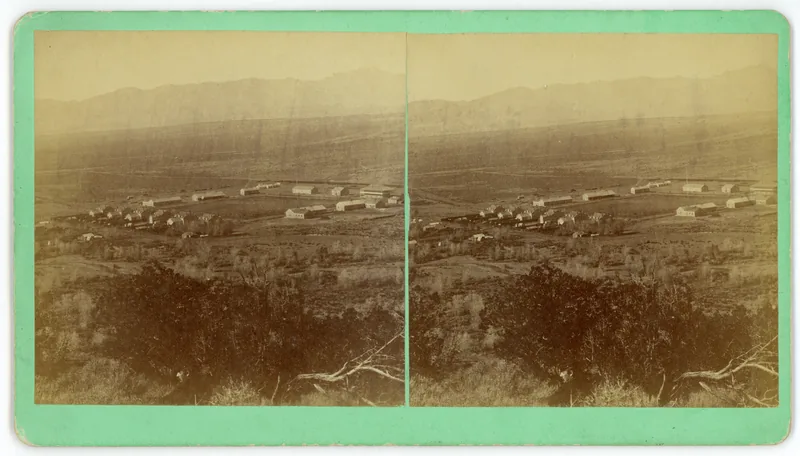
The card of Fort Cameron, Utah Territory, photographed by James Fennemore circa 1875, sits inside the official span of greatest popularity. Official holdings wording on the same Library of Congress page covers images produced from the 1850s to the 1940s, with the bulk of the collection dating between 1870 and 1920. Two official collection-size figures on that page are kept apart: “more than 50,000 stereograph cards in the Prints & Photographs Division’s holdings,” and “Approximately 52,000 stereographs are organized and available in the Stereograph Cards collection.” This desk does not blend them into a single number.
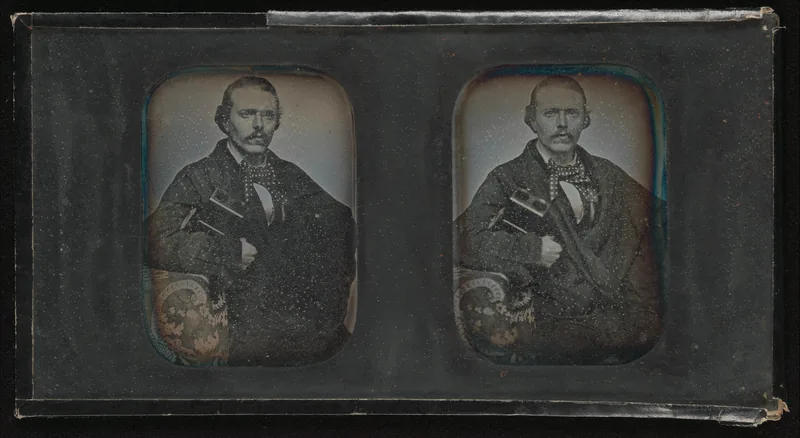
The portrait of a man holding a viewer, from the Metropolitan Museum of Art, is dated on its file to the 1840s–60s. That range is kept as written. It is not used to “correct” the official wording that stereographs were first made in the 1850s.
Enjoyed this desk of two flat pictures that look solid?
No pop-ups. No intrusive advertising. Just interesting stuff. A little support helps the next illusions.im site get built.